- Super Eagles AFCON 2027 qualification — Group L table explained: why 2nd place may not be enough for Nigeria
- The March fixtures and the exact results Nigeria need
- Life without Osimhen — Arokodare, Lookman and the goals problem
- Chelle under pressure — what the Tanzania draw changed
- AFCON 2027 outright market — how to read Nigeria's price honestly
- Frequently asked questions
The Super Eagles AFCON 2027 qualification situation in one sentence is this: Nigeria are second in Group L on 7 points, three behind Guinea-Bissau, and because co-hosts Tanzania qualify automatically, second place in this group may not be enough — the final rounds in March 2027, against Madagascar and Guinea-Bissau, will decide everything. A 3–1 win over Tanzania in Uyo on 13 November was followed by a 0–0 draw in Zanzibar four days later, and that dropped point is why the maths below matters so much.
Super Eagles AFCON 2027 qualification — Group L table explained: why 2nd place may not be enough for Nigeria
In a normal qualifying group, second place is a comfort zone. Group L is not a normal group. Tanzania are co-hosts of AFCON 2027, which means they take a place at the finals automatically — and the group’s other qualifying place goes to the highest-placed non-host team. Read that again, because it changes how the table should be read:
| Team | Points | Situation |
|---|---|---|
| Guinea-Bissau | 10 | Currently hold the group’s non-host qualifying place |
| Nigeria | 7 | 2nd, three points behind, with the head-to-head still to come |
| Tanzania | — | Qualify automatically as co-hosts, regardless of group finish |
| Madagascar | — | Still to play Nigeria in the final rounds |
So the real race in Super Eagles AFCON 2027 qualification is not “can Nigeria finish in the top two?” — it is “can Nigeria finish above Guinea-Bissau?” Every other team in the group is, in qualification terms, a supporting act. Nigeria’s 7 points came with a squad missing its best player, which is context worth holding onto; but the table does not award style points, and three points is a real gap with only the final rounds left to close it.
This is also why results elsewhere in the group matter less than fans often assume. Nigeria do not need favours from Madagascar or Tanzania nearly as much as they need to handle their own two fixtures — one of which is against the very team they are chasing.
The March fixtures and the exact results Nigeria need
The Super Eagles AFCON 2027 qualification campaign concludes in March 2027 with Nigeria facing Madagascar and Guinea-Bissau. The Guinea-Bissau game is the centrepiece: it is effectively a play-off for the group’s non-host place, and Nigeria go into the window knowing the broad shape of what is required:
- Beat Guinea-Bissau, and Nigeria wipe out most or all of the three-point gap in a single night — with the head-to-head result itself likely to matter if the teams finish level.
- Beat Madagascar as well, and Nigeria give themselves the maximum points total available from the window, removing any dependence on goal difference or other groups’ outcomes.
- Drop points in either game, and the Super Eagles are relying on Guinea-Bissau slipping up elsewhere — possible, but no longer in their own hands.
The honest summary is that Nigeria’s fate is still in their own hands, but the margin for error has gone. November offered four points from the Tanzania double-header when six were there to be taken; March offers no such cushion. Two wins is the clean target. Anything less turns the final day into a calculator exercise — and Nigerian fans have lived through enough of those.
One more variable hangs over the whole window: the fitness of Victor Osimhen, covered below, because the difference between Nigeria with and without him was visible across the November fixtures.
Life without Osimhen — Arokodare, Lookman and the goals problem
Nigeria played the entire Tanzania double-header without Victor Osimhen, who had arthroscopic surgery on his left knee on 7 November after injuring it against Stuttgart on 3 November. His absence framed both games.
The good news came in Uyo: Tolu Arokodare scored twice in the 3–1 win, the kind of performance that turns a deputy into a genuine option. Arokodare gives Nigeria a physical focal point — hold-up play, aerial presence, penalty-box occupation — and two goals in a must-win home game is exactly the audition a stand-in striker needs to pass.
The concern came in Zanzibar: a 0–0 draw in a game Nigeria needed to win. One goalless game proves nothing on its own — away qualifiers in East Africa are awkward fixtures, and Tanzania, playing at home with a finals place already secured, had every reason to make it a scrap. But the pattern is worth stating plainly: without Osimhen, Nigeria’s attack depends heavily on moments from Ademola Lookman and on Arokodare converting a smaller number of chances. Osimhen does not just score; he pins two centre-backs, stretches the pitch and creates the space Lookman plays in.
As of late November, Osimhen’s return is not confirmed. His club coach has tied a possible comeback to how the knee responds to training, and no firm date has been set publicly. Nigerian fans should treat any “he will definitely be back” claim — for club or country — as unconfirmed until Galatasaray name him in a squad. For March, the planning assumption in Super Eagles AFCON 2027 qualification has to be that Chelle prepares both versions of his team: the one built around Osimhen, and the one that just took four points from six without him.
Chelle under pressure — what the Tanzania draw changed
Éric Chelle’s position is not in immediate danger — four points from a double-header, away draw included, is not a sacking return, and the squad he picked included a first call-up (Suleiman Mubarak) that signals a coach still building rather than clinging on. But the Zanzibar draw changed the temperature around him in two ways.
First, it removed his insurance. A win in Zanzibar would have put Nigeria level with Guinea-Bissau and made March a formality to manage; instead, March is now a high-stakes window in which a bad week ends a qualifying campaign — the kind of week that defines a Nigeria coach’s tenure either way.
Second, it sharpened the selection questions. Does Arokodare’s brace earn him a starting place even if Osimhen is fit, with Osimhen’s return changing the shape around him? How does Chelle balance Lookman’s freedom with defensive security in an away game Nigeria may need to win? These are good problems when results go well and brutal ones when they do not.
The fair assessment is that Chelle has done enough to keep control of the story, but no more than that. Coaches of Nigeria are ultimately judged on qualifying for tournaments — and this one will now be judged in a single March week, when Super Eagles AFCON 2027 qualification is decided.
AFCON 2027 outright market — how to read Nigeria’s price honestly
Nigeria will appear in AFCON 2027 outright markets at a price that reflects their reputation — three-time champions, a squad full of European-league players — more than their current Super Eagles AFCON 2027 qualification position. That gap between reputation and reality is exactly where bettors need to be careful, in both directions:
- Nigeria are not yet qualified. Any outright price quoted today carries an unpriced risk: a bad March means the bet is dead before the tournament exists for them. Bookmakers’ outright odds rarely scream that warning.
- The price will move on Osimhen news. If he returns and plays through the spring, Nigeria’s outright price will shorten whether or not the underlying team has improved. If his knee problem lingers, it will drift. Neither move, on its own, tells you the bet is good or bad value.
- Qualification comes first, opinions second. The sensible sequence is to treat March as the event that creates the real information — the squad, the system, the striker’s fitness — and only then judge whether an outright price is fair.
For today’s football, see our Pick of the Day and the daily markets on the Sure Soccer Predict homepage. If you build the March qualifiers into an accumulator when they arrive, our accumulator betting guide explains why the margin multiplies with every leg — a warning that applies doubly to must-win international fixtures, where motivation and game state distort normal form.
Frequently asked questions
Are Nigeria qualified for AFCON 2027?
No. In the Super Eagles AFCON 2027 qualification race, Nigeria are 2nd in Group L on 7 points, three behind Guinea-Bissau. Because co-hosts Tanzania qualify automatically, the group’s other place goes to the highest-placed non-host team — currently Guinea-Bissau. The final rounds in March 2027 decide it.
What do Nigeria need in March 2027?
Realistically, in Super Eagles AFCON 2027 qualification, two wins — against Madagascar and, above all, Guinea-Bissau. Beating Guinea-Bissau head-to-head is the single most valuable result available, because it closes the three-point gap directly. Anything less leaves Nigeria dependent on other results.
Why did Nigeria drop points against Tanzania?
After winning 3–1 in Uyo (Tolu Arokodare scored twice), Nigeria drew 0–0 away in Zanzibar on 17 November. They played both games without the injured Victor Osimhen, and the away performance lacked the cutting edge his presence usually provides.
Will Victor Osimhen be fit for the March qualifiers?
It is unconfirmed. Osimhen had knee surgery on 7 November 2026, and his club have set no confirmed return date — his coach has said a comeback depends on how the knee responds. March is months away, which helps, but as of late November there is no guarantee either way.
Who is Nigeria’s coach for the qualifiers?
Éric Chelle. He remains in charge after the November window, but the March fixtures against Madagascar and Guinea-Bissau will define his tenure, because qualification is now decided in that single window.
Responsible betting: Betting is for over-18s only. Nothing in this article is a guarantee of any result — qualification races and outright markets are uncertain by nature, and Nigeria have not yet qualified. Never bet more than you can afford to lose, and never chase losses. If betting stops being fun, seek help from GambleAware (UK) or the responsible-gambling support offered by licensed operators in Nigeria.
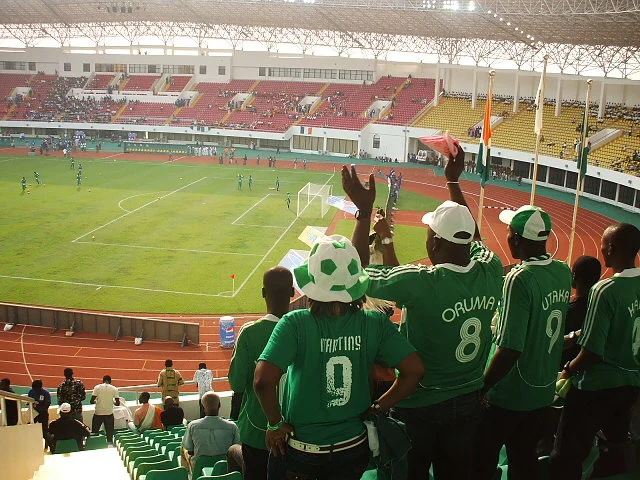
Photo: Oluniyi David Ajao, CC BY (Nigerian fans at AFCON 2008) — via Wikimedia Commons

 By Niehof